

Valuation talks go wrong when founder and investor use the same words to mean different things. Here are pre-money, post-money and dilution in plain English, with the terms around them and one simple worked example. The figures in the example are invented for illustration.
The terms
Pre-money valuation. What the company is agreed to be worth immediately before the new money goes in. This is the number that sets the share price for the round.
Post-money valuation. The pre-money valuation plus the new investment. A company valued at £4m before raising £1m is valued at £5m afterwards.
Price per share. The pre-money valuation divided by the number of shares counted before the round. It decides how many new shares the investor receives for their money.
Fully diluted share capital. Every share in issue plus every share that could be issued: options, warrants and instruments that convert into shares. Investors usually want the price worked out on this basis because it shows what they will really own.
Dilution. The fall in your percentage ownership when new shares are issued. You keep the same number of shares, but each one is a smaller slice of what should now be a larger company.
Option pool. Shares set aside to reward future staff. Whether the pool is created before or after the price is set matters a great deal, as the example below shows.
Convertible instruments. Convertible loan notes, advance subscription agreements and similar instruments that turn into shares at a later round, often at a discount. They cause dilution when they convert, so they belong in your calculations now.
Anti-dilution protection. A clause that protects an investor if a later round is priced lower than theirs, usually by adjusting the price at which their shares convert. The weighted average version is common; the full ratchet version is much harsher on founders.
Pro rata rights. The right of an existing investor to put money into future rounds to keep their percentage from shrinking.
Cap table. Short for capitalisation table: the record of who owns what, before and after each round.
A worked example
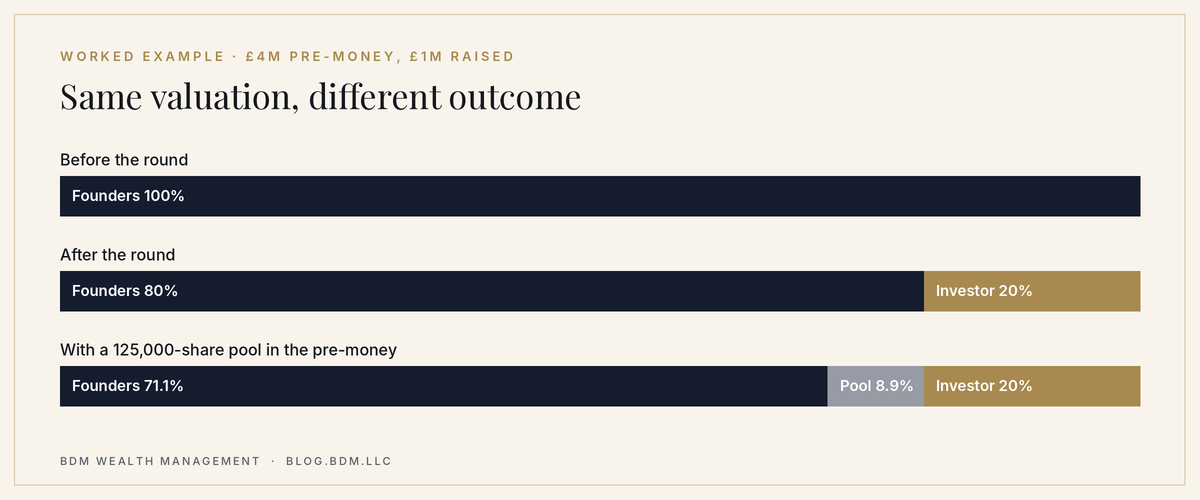
The founders own 1,000,000 shares, which is 100% of the company. They agree a £4m pre-money valuation with an investor who puts in £1m.
- Price per share: £4m ÷ 1,000,000 = £4.
- New shares for the investor: £1m ÷ £4 = 250,000.
- Total shares after the round: 1,250,000. The investor owns 20%, the founders 80%.
- Post-money valuation: £5m. The founders’ 80% is worth £4m on paper, the same as their 100% was worth before.
That is the point people miss. Dilution is not a loss of value on its own. It is a trade: a smaller share of a company with more money to grow.

The option pool twist
Now suppose the investor asks for a pool of 125,000 shares to be created before the round and counted in the pre-money valuation. The headline stays at £4m pre-money, but it is now spread across 1,125,000 shares, so the price falls to about £3.56. The investor’s £1m buys 281,250 shares. After the round, the investor still owns 20%, the pool about 9%, and the founders about 71% rather than 80%.
Same headline valuation. Nine points less for the founders. Always ask where the pool sits.
How they fit together
The pre-money valuation and the share count set the price. The price and the investment set the new shares. The new shares set the post-money position and the dilution. Option pools, convertibles and anti-dilution clauses all change the share count, either now or later, which is why two offers with the same headline valuation can leave you with very different stakes.
Before you compare term sheets, ask three questions of each one: is the valuation pre-money or post-money, is the price on a fully diluted basis, and is the option pool inside the pre-money figure? Then build a simple cap table for each offer and compare what you would actually own. There is more on preparing for a round in our raising capital articles.
This article is general information, not financial, legal or tax advice. If you are planning a raise, talk to BDM Capital.
Frequently asked questions
Pre-money is the value placed on the company before new investment; post-money is pre-money plus the money raised. The investor’s percentage equals the amount invested divided by the post-money valuation.
Each existing shareholder’s percentage falls by the proportion of new shares issued. If a round sells twenty percent of the post-money company, every existing holder’s stake shrinks by one fifth unless they participate.
Not if the money raised increases the value of the company by more than the dilution. Owning a smaller share of a much larger business can leave a founder better off in absolute terms.