

A pitch deck has one job: to get a meeting. Most investors give a deck only a few minutes on the first read. In that time they are looking for answers to a small number of questions. A deck that answers them clearly gets a meeting. One that makes them hunt usually does not.
The questions every deck must answer
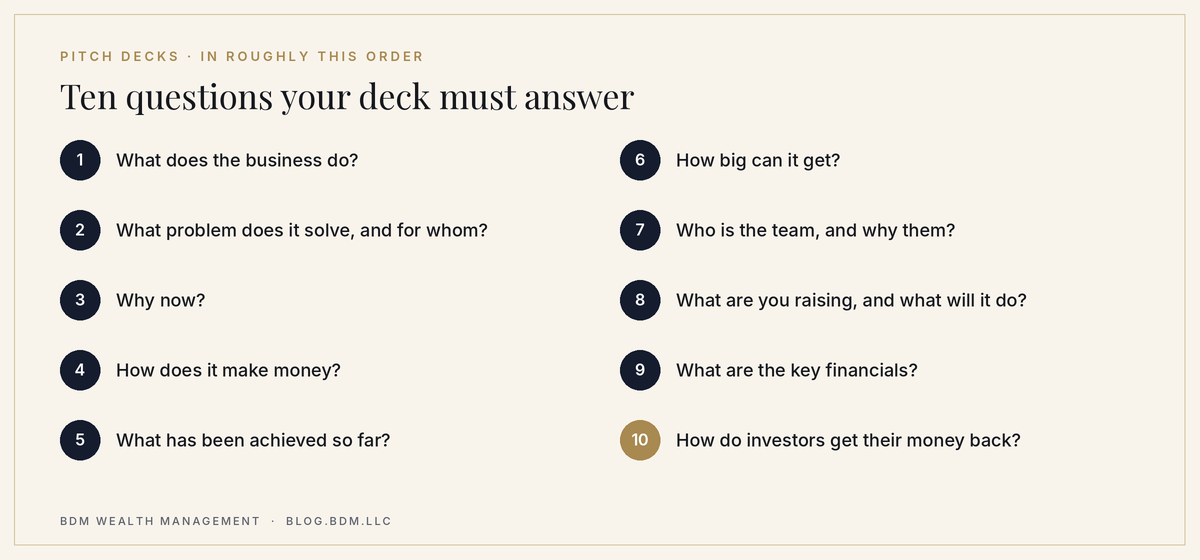
In roughly this order:
- What does the business do? One sentence, on the first slide.
- What problem does it solve, and for whom?
- Why now? What has changed that makes this the right moment.
- How does it make money? The business model, plainly stated.
- What has been achieved so far? Revenue, customers, contracts, milestones.
- How big can it get? A realistic view of the market you can actually reach.
- Who is the team, and why them?
- What are you raising, on what instrument, and what will the money do?
- What are the key financials? Past results and a credible forecast.
- How do investors get their money back?

Common mistakes
- Burying the business. If an investor reaches slide four without knowing what you do, you have lost them.
- Too much text. A deck supports a conversation. It is not the information memorandum.
- Unrealistic numbers. Forecasts that climb steeply with no explanation damage credibility for everything else.
- Vague use of funds. “Growth” is not an answer. Say what the money will buy and what it will achieve.
- No exit. Especially for debt, investors need to see how and when they are repaid.
Keep it consistent
The deck, the information memorandum and the financial model must tell the same story with the same numbers. Investors notice inconsistencies, and they read them as a sign of how the business is run.
A short, clear deck that answers the obvious questions is more persuasive than a long one that tries to say everything.
Mark Johnson is the Founder of BDM Capital, which introduces capital raising opportunities across bonds, loan notes, IPOs and SEIS/EIS. To discuss a raise, get in touch.
Frequently asked questions
The problem and solution, the evidence of traction, the team, the financial summary and the ask. Most skim the rest. Those five slides decide whether a conversation happens.
Enough to cover those five areas plus market, competition, model and use of funds, typically ten to fifteen. Supporting detail belongs in an appendix or the data room.
Claims without evidence, numbers that do not match the model, no clear ask, and a design that puts style ahead of readability. Investors are reading for reasons to stop; the deck should remove them.
BDM Capital is not authorised or regulated by the Financial Conduct Authority. This article is general information, not financial, tax or legal advice, and does not constitute an offer or invitation to invest. Capital is at risk and you may get back less than you invest. Written for founders and directors of businesses considering a raise. Take independent professional advice before making any investment decision.